

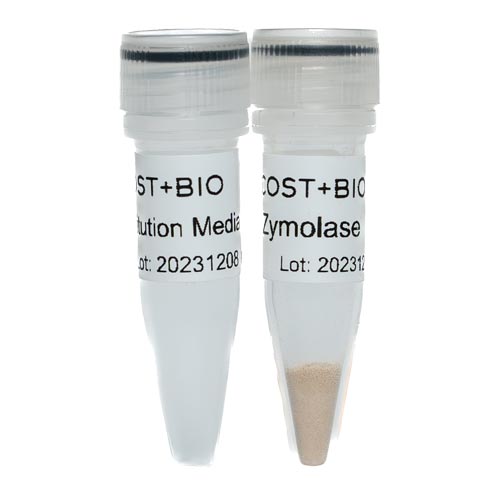
Product Information
Zymolyase 100T: Your Solution for Efficient Cell Wall Digestion
Unlock the potential of your research with Cost Plus Zymolyase 100T, the cutting-edge enzymatic solution designed to streamline cell wall digestion processes. Developed by leading experts in the field, Cost Plus Zymolyase 100T is meticulously crafted to provide researchers, scientists, and biotechnologists with unparalleled performance and reliability.
What About More Dilute Zymolyase Resuspensions?
We recommend using Zymolyase resuspension buffer if resuspending Cost Plus Zymolyase 100T 400U or 800U in volumes greater than 500 or 1000 microliters respectively.
Unit (U) definition: 0.018 +/- 0.006 mg of Zymolyase with the ability to digest 6 mg of brewers yeast within 2 hours at 25 degrees celsius. A measurement of confirmation can be determined as a 30% decrease in absorbance @ 800nm wavelength.
Why pay more when you can get virtually the same enzyme solution at generic prices?
Trust Cost Plus Zymolyase 100T for Your Research Needs
Backed by years of scientific expertise and a commitment to excellence, Zymolyase 100T is the trusted choice for researchers seeking superior performance in cell wall digestion. Elevate your research capabilities and accelerate discovery with Cost Plus Zymolyase today. Specifically, unlock the potential of your experiments and pave the way for groundbreaking insights in biology and biotechnology.
Enzymes: Beta-1,3-glucan laminaripentaohydrolase, Beta-1,3-glucanase, Protease, Mannanase
Lytic specificity: Ashbya, Candida, Debaryomyces, Eremothecium, Endomyces, Hansenula, Hanseniaspora, Kloeckera, kluyveromyces, Lipomyces, Metschnikowia, Pichia, Pullularia, Torulopsis, Saccharomyces, Saccharomycopsis, Saccharomycodes, Schwanniomyces, and others.
| Form | |
|---|---|
| Lyophilized Powder | |
| Purification | |
| Affinity Chromatography | |
| Activity | |
| 100,000 units/g | |
| Essential enzyme | |
| β-1,3-glucan laminaripentaohydrolase | |
| Other activitiescontained | |
| β-1,3-glucanase | approx. 1.0 x 10⁷ units/g |
| protease | approx. 1.7 x 10⁴ units/g |
| mannanase | approx. 6.0 x 10⁴ units/g |
| Contaminants | |
| Amylase, Xylanase, Phosphatase | Non detectable |
| Optimum pH and Temp. | |
| pH7.5, 35°C (for lysis of viable yeast cells) pH6.5, 45°C (for hydrolysis of yeast glucan) |
|
| Stability | |
| 2°C | No loss of activity was found after storage for 1 year |
| Heat stability | |
| 30°C | 90% of the lytic activity is lost after storage for 3 months |
| 60°C | Lytic activity is lost on incubation for 5 minutes |
| Specifi city (Lytic Spectrum) | |
| Ashbya, Candida, Debaryomyces, Eremothecium, Endomyces, Hansenula, Hanseniaspora, Kloeckera, kluyveromyces, Lipomyces, Metschnikowia, Pichia, Pullularia, Torulopsis, Saccharomyces, Saccharomycopsis, Saccharomycodes, Schwanniomyces, etc. | |
One unit of lytic activity is defi ned as that amount which indicates 30% of decrease in absorbance at 800 nm (A800) of the reaction mixture under the following condition.
| [Reaction Mixture] | |
|---|---|
| Enzyme solution | 1 ml (0.012-0.024 mg/ml) |
| Brewer's yeast cell suspension | 3 ml (2 mg/ml) |
| 1/15M Phosphate buffer | 5 ml (pH7.5) |
| Distilled water | 1 ml |
After incubation for 2 hours at 25°C with gentle shaking, A800 of the mixture is determined. When 60% of A800 decrease, equivalent to 2 units, is observed in the reaction system, the brewer’s yeast cells are completely lysed, namely 1 unit of Zymolyase lyses 3mg dry weight of brewer’s yeast.
- High Efficiency: Cost Plus Zymolyase 100T boasts exceptional enzymatic activity, ensuring swift and thorough degradation of cell walls in yeast. Most importantly, this efficiency saves valuable time in your experiments, allowing you to focus on analysis and results interpretation.
- High Stability Consistent Results: You will expect reproducible outcomes batch after batch. Furthermore, rigorous quality control measures ensure uniform enzyme activity and stability, empowering you to achieve reliable results with every experiment.
- Flexibility User-Friendly Formulations: Available in convenient lyophilized formats that can be reconstituted with pure water or with our ready-to-use liquid buffer formulations, Cost Plus Zymolyase 100T offers flexibility to suit your experimental needs. Additionally, our product is designed for seamless integration into your workflow.
- 400U: add 80 microliters of pure water and mix gently
- 800U: add 160 microliter of pure water and mix gently

(Data courtesy of Masako Osumi, Emeritus Professor at Nippon Women's University)
- Avoid using nitrocellulose filters and use of material other than nitrocellulose when sterilizing. Zymolyase may be adsorbed on nitrocellulose membranes.
- Zymolyase-100T may not be completely dissolved in buffers. Use Zymolyasesup as suspension.
- When sterilized, Zymolyase is used in a concentration higher than 0.05%, prepare 2% Zymolyase solution in buffers containing 5% glucose, fi lter the suspension and dilute the solution with the appropriate buffer.
